
In a different kind of pickle
Badminton and table tennis have had a baby, and its name is Pickleball.
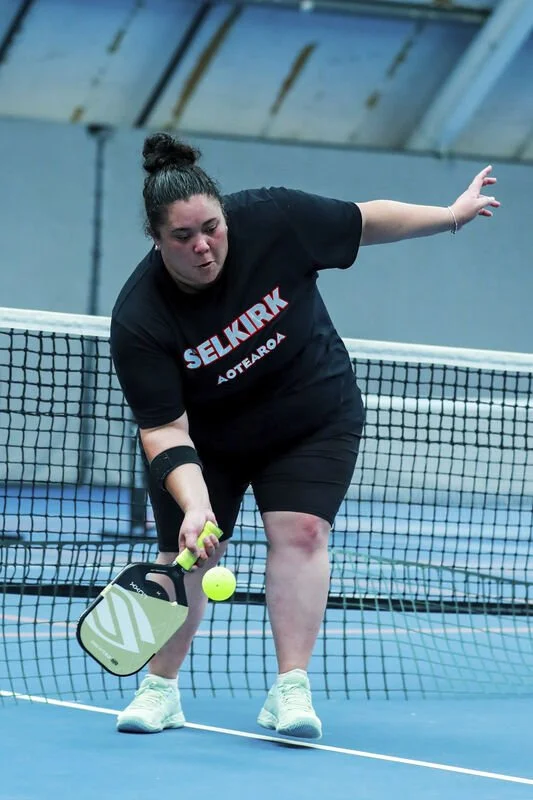
Ashley Gage sits among the top 10 female players in the country. PHOTO: FOXALL PHOTOGRAPHY
Pickleball is widely agreed to be the fastest-growing sport in the world. Hailing from the US, where it has been swiftly growing in popularity since the mid-1960s, it landed in Aotearoa New Zealand only nine years ago. The game looks a bit like tennis and can be played indoors or outdoors, but the key differences are that the bats are smaller, the balls are plastic, and the courts are far smaller – think a badminton-sized court.
With two pickleball courts able to fit in one single tennis court, there is a lot less running around – perfect for older people and those who have had to give up other racquet sports for health reasons. Pickleball is perhaps the perfect game for almost anyone, regardless of age, size, or fitness level.
RACQUET MAN
Father of two teens with type 1 diabetes, Paul Abbott is also in the same camp, diagnosed 28 years ago. The Wellingtonian hasn’t been playing pickleball for long but says he has loved every minute of it.
‘It’s so much fun. I’m addicted to it. I’ve only been playing a year. I’ve played all the racquet sports in my past lives, most recently table tennis, but I haven’t picked up a table tennis bat since I first started playing pickleball. All my energies are going into it.’ In his first year, Paul played and won in two tournaments, and he won the B grade doubles with his partner at the Battle of the Paddle in Hawke’s Bay last year.
Paul says he definitely feels some advantages from his table tennis and tennis background. ‘Anyone who has played a racquet sport will pick it up easily, but you don’t have to have that history. There are people there who have never played any racquet sports, and they’re great at pickleball.’
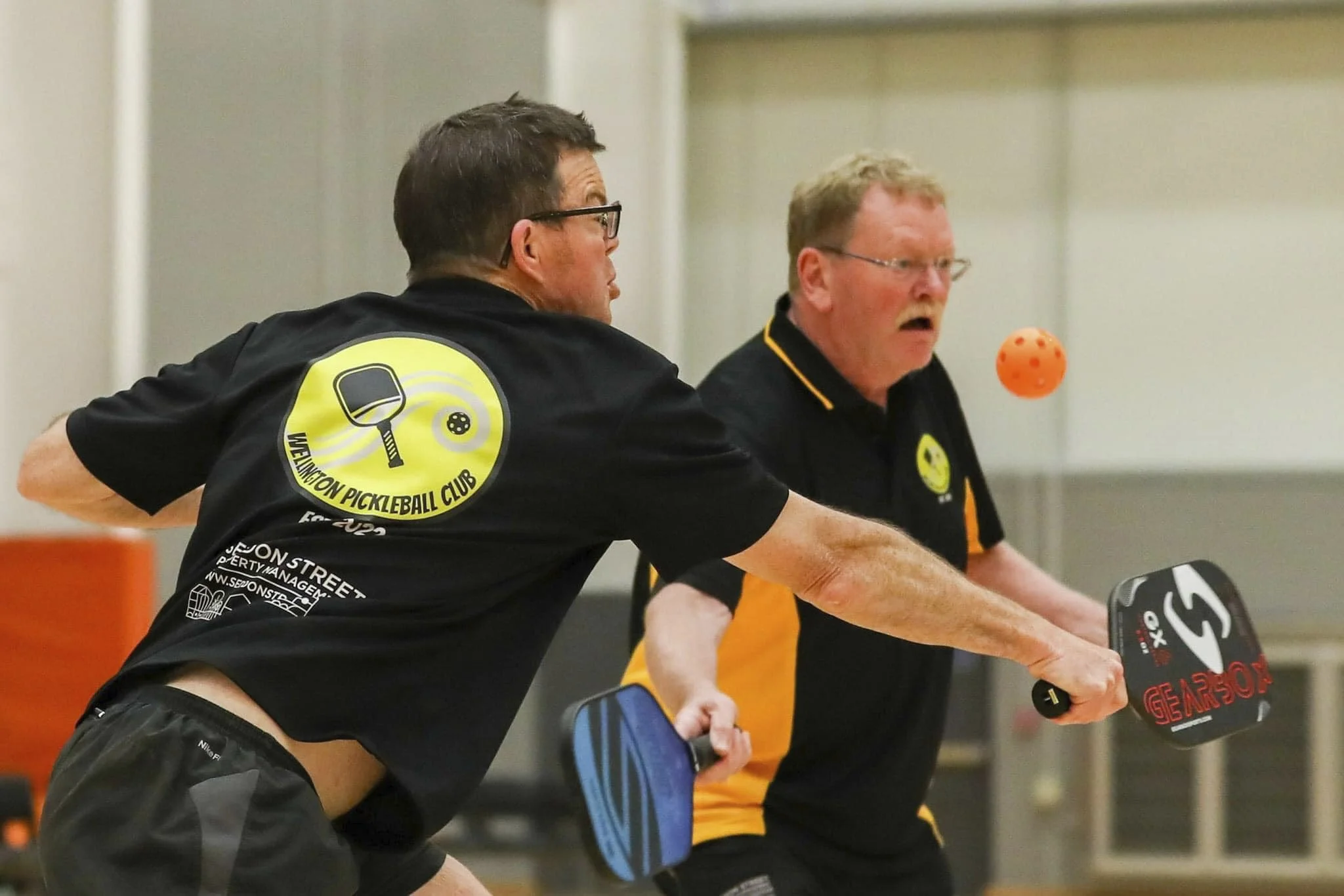
Paul Abbott and his partner Graham Halliday. CREDIT: FOXALL PHOTOGRAPHY
Sixty years young, Paul explains that pickleball is also a game where age isn’t a barrier. In fact, it can often be a bonus. ‘You can be over 60 and still be a really competitive player.’ There’s not as much running as tennis, instead more of a focus on hand–eye coordination at the net. ‘You’ll see some players with knee braces, who are not as agile as they once were, but they are still very effective pickleball players.’
Most rec centres have pickleball as an option now. The set-up is easy, requiring only a badminton sized court and a portable net, which is lower than a tennis net. The whole set-up comes in a bag, making it a very portable sport.
Paul plays up to three times a week and crosses Wellington in order to play at Ākau Tangi Sports Centre in Kilbirnie. ‘It’s a bit of a drive, but it shows how much I love to play.’ He enjoys the social side of the sport as well, an experience echoed by each of the ‘picklers’ we spoke to.
ASH, TOP 10
Ashley Gage (Ngāpuhi, Ngāti Kahungunu) entered the sport after a couple of decades of playing premier-level netball. Too many injuries had her seeking a new sport that would still challenge her but that would be far gentler on the joints. Her surgeon had warned that if she had one more injury to her ankles then she would have to have plates put in and that this would put an end to any running.
Along she went to the local courts, having no idea what pickleball was but knowing it was a bit like padder tennis. In her first taste of the game, Ash played a 73 year old and so naturally assumed she would have it easy. ‘He absolutely annihilated me! I have never been so pulverised in a sporting situation. But what I could appreciate from that was the skill he had. He had very low mobility. He didn’t have the power of a 40 year old. But he was able to annihilate a 30 year old. That taught me that there is a lot of skill in this game and that mobility is a perk but not a necessity.’
Four and a half years later, Ash now sits among the top 10 female players in the country.
ASH, DNS
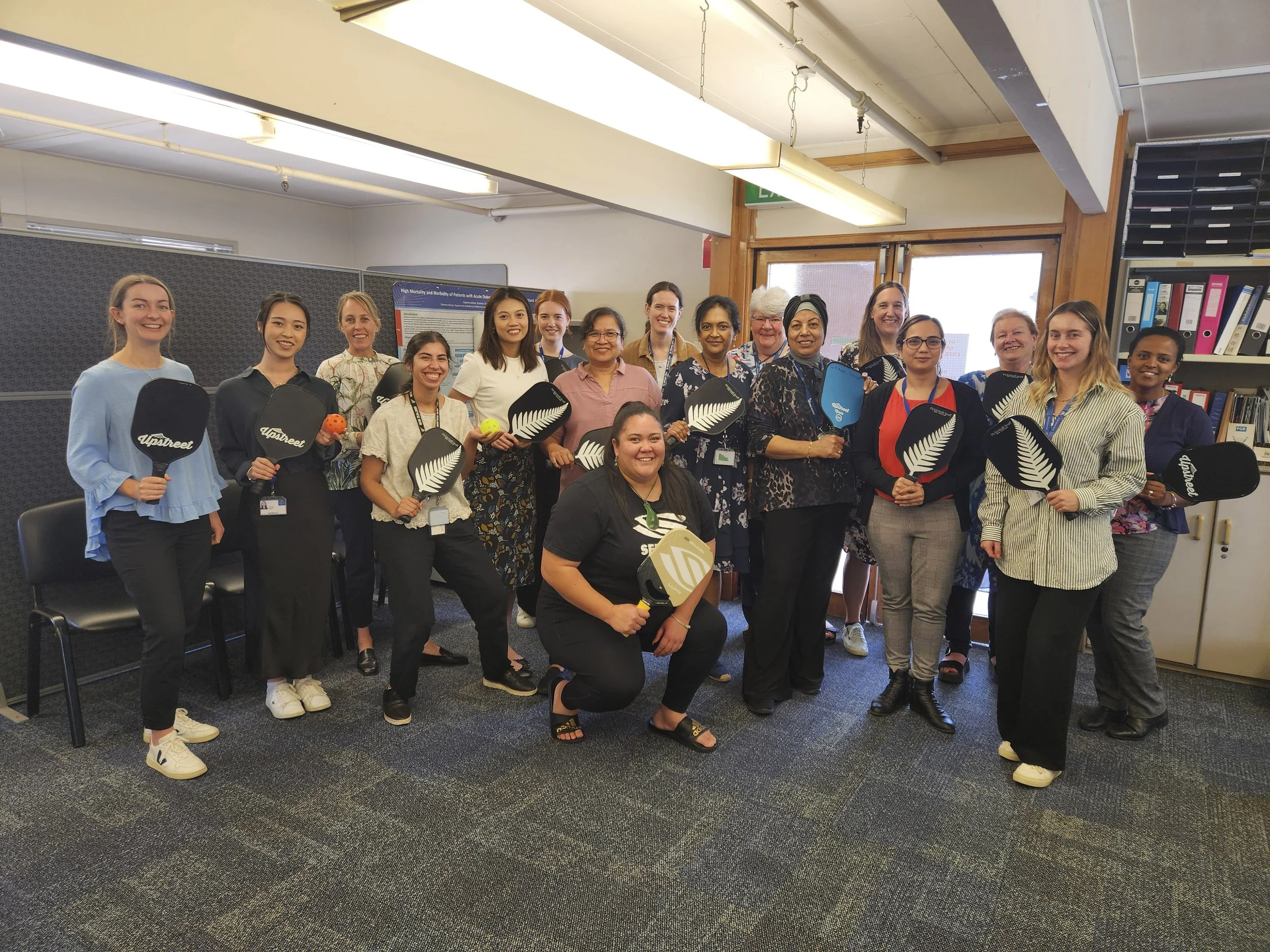
Ash and her team at Whitiora Diabetes Service. Although they've not all played yet, they have plans to 'pickle' in the near future as a team bonding session.
As well as being the Chair of South Auckland Pickleball, running a club responsible for two sites in Auckland, Ash is also a Diabetes Nurse Specialist. She says her patients might notice her moving just a bit slower than normal on a Monday morning, and flashing the occasional grimace, so they ask her what’s up. Happy to share what has caused the apparent soreness, she will tell them about a tournament she played in the weekend, which she then uses as a great way to rave about the game and encourage others to give it a go.
‘I tell them where they can play. I say, “If you come to any of my sites I will not approach you as a patient. Nobody will ever know that you have diabetes unless you say it. You’re more than welcome to talk to me about it, but I will never approach you.” I lay that down straight off.’ She estimates she’s encouraged about 15 patients into pickleball.
Working within Counties
Manukau, Ash’s patient base is largely Māori and Pasifika, ethnicities that have seen a more positive rise within the pickleball world. When Ash first started playing, she noticed she and her partner were among a very small population. ‘When I first started playing, there were only five Māori playing in the country. No Pacific Islanders. Just five of us Māoris. And me and my partner were two of them!’ Back then, she says there were only about 1000 players nationwide. Now there are close to 9000, with a huge contingency of Māori and Tongan players. The latter are often supported by the Mormon church. ‘It’s very refreshing to see when we know the prevalence of diabetes in those communities.’
Each Easter weekend, the Annual Tongan Tournament draws the Tongan pickleball community to South Auckland for a weekend of competition. This tournament also proves that the game isn’t just for adults, with divisions for kids as young as four.
DIFFERENCES IN AGE?
‘Realistically, when you’re playing in the top ranks of the game, mobility definitely does help. Equally, if you’re heading towards winning tournaments or being in the top 10, you definitely need mobility because of how fast that ball can travel. You’ve got to be able to move. But if you’re among the seniors, mobility isn’t really necessary. But the strategy of the game changes. They’re very good at things like placement of the ball, reading the game, reading what you’re doing, and countering you before you’ve even hit the ball. They play with a lot of intelligence, a lot of smarts to them. We call them our Masters grade for a reason. Because they’re just that good.’
KEITH, PADDER TENNIS PRO
Keith Kenderdine, retired accountant and long-time Tawa Lions Club member, was attending a community coordinators’ meeting where someone reported to the group about a wonderful new racquet sport they were playing and suggested everyone come and give it a go. That was two years ago, and Keith hasn’t stopped since, playing every Wednesday morning for two hours and Friday for an hour and a half.
‘Supposedly, it was invented by the US in 1965. But, in 1955 I played a game called padder tennis.’ The two games look similar, but padder tennis is a separate game in its own right. Originating 80 years earlier than pickleball, it uses a tennis ball, requires a slightly larger court, and employs different scoring. The modern bats now have holes, and the game is promoted more to children than adults.
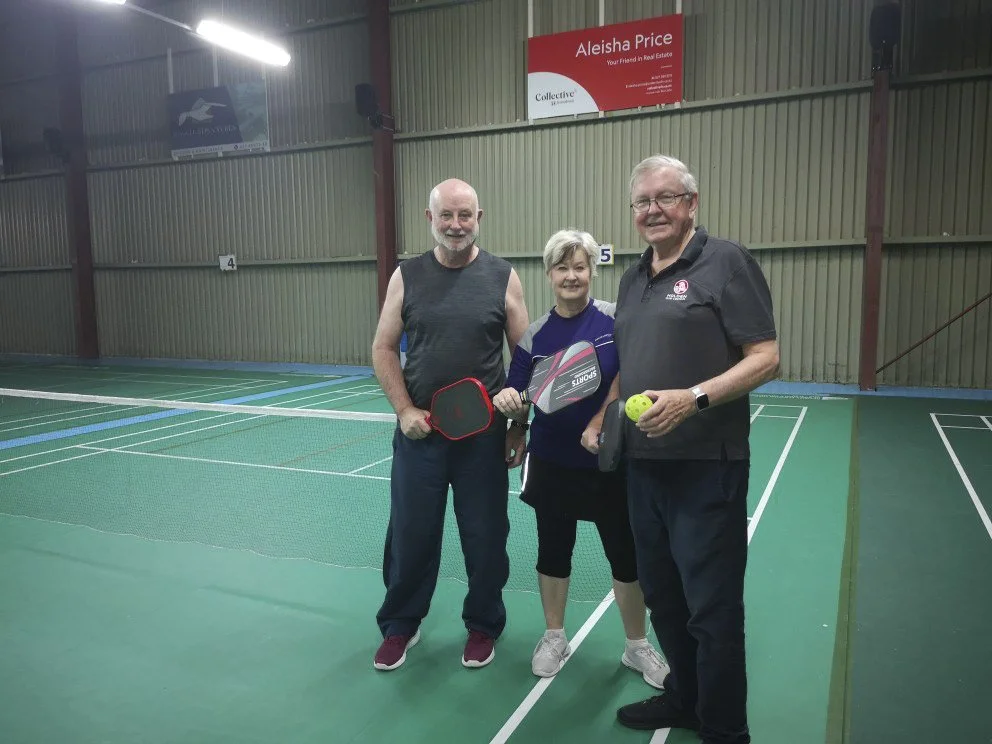
Keith Kenderdine in between games with fellow picklers, Terry and Gaylene Hughes.
Keith jokes that it’s the morning tea that the club members all share on Wednesdays that pulls him back each week. But the enjoyment of the game is a strong factor as well, not to mention the company of his fellow players. ‘The big attraction is the companionship. I’m a widower, so anything to get out and mix with other people is a good thing, even if it means I’ve got to beat them at pickleball. But they don’t see it quite the same light for some reason,’ he quips.
The exercise that pickleball offers is constant but mild, depending on the level you play at, of course. Games only last 10 minutes, but in that time you are constantly moving in the quick but gentle sport. ‘The game is as energetic as you want it to be’, Keith says.
Keith started playing when he was 78 and quickly realised his mind was fitter than his body and that he needed to take it gently. ‘The first game I played I sprained my ankle. I realised I’m not as fit as when I was 20. Now I let the impossible shots go through to the back wall and forget about it. That’s my philosophy.’ Now 80 years young, Keith says he’s not the oldest player in his club. Another spritely gentleman, three years his senior, always walks from his home to the courts, a distance of three or four kilometres.
WHY PICKLE?
‘Welcome to the addiction!’ was the reaction from Ash, the nurse specialist, when our Diabetes Wellness writer mentioned she was keen to try pickleball.
As Paula Duffy, Wellington Pickleball committee member, puts it: ‘Addiction occurs quite quickly for a number of reasons. A, the exercise, B, it’s very social, C, the diversity. It’s really a community, a feel-good sport. Everyone wants the same things. It is competitive, but it doesn’t get nasty. ‘There are clubs throughout New Zealand. We all work together, we all talk together. We volunteer at each other’s tournaments. We share knowledge. I’m going over to Australia for a tournament, going to get some learning from there. The Aussies have been amazing, helping us to grow the sport in New Zealand. They’re a few years ahead of us, but they’re not holding it into themselves. It’s a sharing sport. I think everyone feels that when they come in to play.
‘I love seeing sons playing with their fathers. You’ve got husbands and wives, grandparents and grandchildren playing together. It’s phenomenal.
‘We’ve created sister clubs with Queenstown, Hawke’s Bay, and Levin. When their members come and play here, they play member rates. A nice thing to do, to welcome other players.’
WHERE TO PICKLE?
With memberships starting as low as $40 a year, and an entrance fee of around $5, there are 56+ clubs spread all around Aotearoa New Zealand, from Kerikeri to Gore. The entrance fee covers the use of a paddle until you’re ready to purchase your own. Check out www.pnza.org.nz/whereto-play to find a club near you.